
 "
And It's One, Two, Three,
"
And It's One, Two, Three,
What Are We Fighting For ?
Don't Ask Me, I Don't Give A Damn,
Next Stop Is Vietnam.
And It's Five, Six, Seven,
Open Up The Pearly Gates,
Well There Ain't No Time To Wonder
Why
Whoopee! We're All Gonna Die."
To listen to Country Joe's I-Feel-Like-I'm-Fixin'-To-Die-Rag
The
seeds of the Vietnam Anti-war movement were sown as early as the mid
1950’s. This movement originated out of anti-nuclear t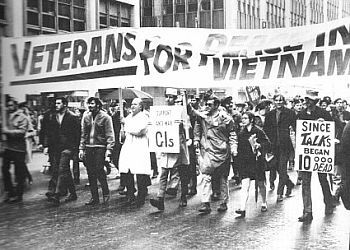 esting
movements, and was developed through campus student organizations in the
early 1960’s. Full fledged opposition to the war did not become prominent
until the end of 1964. The increase in protest in 1964 coincided with
American escalation in Vietnam. By 1969 the members of the anti-war movement
included doctors, lawyers, hippies, students, teachers, veterans, etc. The
movement peaked in 1969, but quickly began to fade out because public
support of Nixon and his withdrawal plan increased.
esting
movements, and was developed through campus student organizations in the
early 1960’s. Full fledged opposition to the war did not become prominent
until the end of 1964. The increase in protest in 1964 coincided with
American escalation in Vietnam. By 1969 the members of the anti-war movement
included doctors, lawyers, hippies, students, teachers, veterans, etc. The
movement peaked in 1969, but quickly began to fade out because public
support of Nixon and his withdrawal plan increased.
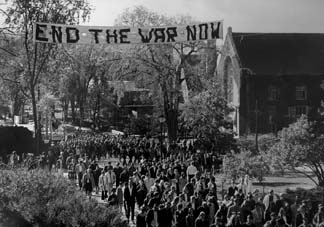 The
music of the time period reflected the growing hatred toward the war, as
well as served as a rallying force for the anti-war movement. Artists such
as Bob Dylan, Country Joe McDonald, and Pete Seeger dedicated their music to
diagnosing the problems with the U.S. involvement in the Vietnam conflict.
Through their music they developed a collective identity among those who
were fighting in the war, and those who lost family members to the war.
This project explores how music moved masses of people to protest.
The
music of the time period reflected the growing hatred toward the war, as
well as served as a rallying force for the anti-war movement. Artists such
as Bob Dylan, Country Joe McDonald, and Pete Seeger dedicated their music to
diagnosing the problems with the U.S. involvement in the Vietnam conflict.
Through their music they developed a collective identity among those who
were fighting in the war, and those who lost family members to the war.
This project explores how music moved masses of people to protest.