Collective Identity in Anti-War Music
Thomas Carlyle once said “All deep things are song. It seems somehow the very central essence of us, song; as if all the rest were but wrappages and hulls!” Music moves the soul, it has the unifying ability which words, art, and actions do not posses. Through music people become united at their core, for song, is but “the very central essence” of humankind. Music of the Vietnam War era was no different in terms of its ability to unify masses of people at their anti-war core. The shared fear of losing brothers, sisters, lovers, fathers, sons, and daughters, or their own life united hundreds of thousands of Americans. Those citizens with a shared anti-war sentiment united through the collective identity expressed not only in protest music, but also in the popular music of the late sixties and early seventies to create one of the most powerful social movements of the century. Within both protest and pop music of the sixties and seventies there are two prominent collective identities expressed within the music which helped spur anti-war protest. The first identity expressed in music is that of the mother, father, lover or child struggling with the loss of their soldier. The second identity is that of the soldier being forced to fight in a war which he does not even understand. Both the collective identities of the fighting soldier and the grief-stricken family member are developed through the shared emotional experiences depicted in protest and pop music of the late sixties and early seventies.
The emotional experience of losing a loved one in the war was common throughout the United States during the Vietnam War. This experience was recorded in the music of the time period. Popular music created a collective identity among all those suffering through the death of those lost in Vietnam. This identity was created more through a common emotional appeal than anything else. The music united the families and friends of soldiers at the wounded core of their being. Steve Goodman’s “The Ballad of Penny Evans” effectively captures the emotional suffering of many women on the home front:
“So Once A Month I Get
A Check From Some Army Bureaucrat
And Once A Month I Tear It Up And Mail The Damn Thing Back
Do They Think That Makes It All Right? Do They Think I'll Fall For That
They Can Keep Their Bloody Money, It Won't Bring My Billy Back” (1971)
Frustration surrounded the loss of loved ones, and it was this very frustration which gave birth to protest. Even if the protest was only as small as Penny Evans mailing back support checks from the army. The emotional experience of losing someone they loved helped to united all of those left behind at home.
Through this unity, those left helpless to the power of the war overseas were able to congregate to protest this war that was taking their families from them. This first collective identity not only expressed the shared grief and suffering of those left behind, it also expressed the shared belief that America had no place in this war. Women wanted the world to know how angry they were and they took to protest to display their hostility toward war. They held vigils in front of the Pentagon, and beat on the doors of the Pentagon to show their disdain toward Defense Secretary McNamara and “his” war (DeBenedetti 1990: 172).
In addition to their anger and grief, the women shared the common goal of ending the violence. As was displayed in the protest of several Californian housewives, when they boycotted saran wrap because Dow made napalm in addition to saran wrap (Small 2002:46). Peter Seeger’s song “Where Have all the Flowers Gone?” incorporates both the shared sense of suffering as well as the political goal that the war should end.
“Where have
all the soldiers gone?
Gone to graveyards every one
When will they ever learn?
When will they ever learn?” (1961)
In creating a collective identity through an emotional appeal, music such as Seegers’ was able to unite a group of Americans to protest the war.. In a time when supporting the war was synonymous with supporting our troops, Americans managed to mobilize through music to protest the war for taking away those they loved, while still supporting those who fight. Through music the shared voices of those who lost loved ones in the war were heard around the world.
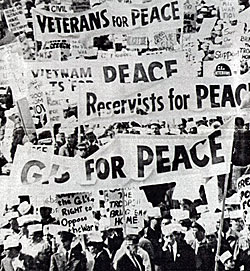
The second and more predominant collective identity, which sparked protest, is that of the soldier who is forced to fight. This soldier is fighting in a foreign land, yet he does not have the opportunity to question why he is fighting. Through the shared war experiences of these soldiers this collective identity is created. The shared belief that they should not be fighting is a large part of this collective identity. Hundreds of war veterans with these common beliefs marched on the White House to return war decorations and discharge papers in protest; they did not believe in the war they were fighting (DeBenedetti 1990: 146). Another major part of the soldier identity is the shared feeling of having no control of their fate because their lives are at the hands of the army bureaucrats. Country Joe and the Fish’s “I-Feel-Like-I’m-Fixin’-to-Die-Rag” capture both the helpless feeling of the soldiers, as well as their questioning of the U.S. presence in Vietnam.
“And It's One, Two, Three,
What Are We Fighting For ?
Don't Ask Me, I Don't Give A Damn,
Next Stop Is Vietnam;
And It's Five, Six, Seven,
Open Up The Pearly Gates,
Well There Ain't No Time To Wonder Why,
Whoopee! We're All Gonna Die” (1965)
Many soldiers felt that were at the mercy of the government. Soldiers felt they served as marionettes for the government; they died not only at the hands of the Vietnamese but at the hands of the government who refused to stop the war.. Music was one of the most common ways of expressing the soldier’s sense of government betrayal. Bob Dylan’s “Masters of War” explores the injustices the soldiers faced at the hands of their own military advisors.
“You fasten the triggers
For the others to fire
Then you set back and watch
When the death count gets higher
You hide in your mansion
As young people's blood
Flows out of their bodies
And is buried in the mud” (1963)
Furthermore, music communicated the frustration of soldiers which in turn helped to create a gathering of veterans to protest this war which they felt was pointless. Through music the soldiers were able to relate to one another. The the collective identity expressed in music such as Country Joe’s “I-Feel-Like-I’m-Fixin’-to-Die-Rag” showed soldiers they were not alone in feeling helpless and confused. In using the first person this collective of confused soldiers, is established. By asking, “what are we fighting for.” the emphasis of the song becomes the soldiers anti-war emotions. Soldiers, influenced in part by music and in part by their own experiences over in Vietnam, became active participants in the anti-war campaigns.
Through the emotional appeal of music of the late sixties and early seventies a social movement was born. The two collective identities depicted in both popular and protest music served as a unifying tool. In being able to relate to the collective identities posed in the music of the time period, both the families of soldiers and the soldiers themselves were able to form protest groups. Collective identity gave these groups a sense of social solidarity. With these groups protestors found solidarity amidst governmental opposition. Wives and families of soldiers were able to relate to one another through the shared sorrow, grief, and frustration. It was the emotional appeal of music which allowed all of these widowed families to share their individual experiences with those who were experiencing the same thing. Music bound them together through their collective identity. Furthermore, the collective identity established in part through music moved these women to action. Music was their call to arms in the war of protest. Soldiers were united as well through the collective identity portrayed in music. Their shared war experiences, frustration, confusion, sorrow, and experiences with death united these men on an almost spiritual level. Music reflected some of their confusion at why they were fighting, as well as their feelings of helplessness against the government. The sense of brotherhood and camaraderie amongst soldiers was established not only through fighting together, but also through the emotions expressed in song. As Thomas Carlyle said, “(song is) the very central essence of us,” not only does music move the soul, it moves people together to create powerful social movements.