|
Like all students taking a history seminar last fall, Cynthia Paces’
class learned about the past. The only difference is that instead
of reading about it in books, her students got the story from living
persons.
It was all part of a new course in oral history taught by Paces.
Eleven students taking her senior seminar were required to interview
a person about a memorable aspect of his or her life that coincided
with an area of historical significance.
According to Paces, oral history became popular in the 1970s and
experienced a resurgence in the 1990s. Part of the reason Paces
likes the field so much is that, "Oral history gives people
a voice when they didn’t have one before. We can’t know
exactly what happened in the past. There’s not just one truth."
Students recorded their interviews with their subjects, verifying
and supporting their discoveries with extensive library research.
Paces said that like every other class, different students received
different things from the class.
"The seminar was a unique way of learning—delving into
a topic, doing research, and piecing it together," Maureen
Camphire ’00 said, "especially the personal interviews.
You can learn so much by listening to people."
Though Paces guided the students, she could not help them every
step of the way. She said that sometimes an interviewee would not
talk about an emotional issue or would get angry because of a certain
question.
"Everyone had something happen in the midst of this that was
troubling," Paces said. "You can’t always get people
to say what you want them to say.
"There’s a sense among some students that when you’re
writing a paper, you work real hard, but in the end, it’s really
only being written for one person—the professor. I wanted it
to last longer than that," said Paces.
Indeed, it has. All of the students’ reports are available
at the library, and Paces plans to begin a Web site this fall that
will archive the projects. Thumbing through the neatly bound copies
of the reports from last year, Paces said students became aware
of their interviewees in various ways. While one student spoke to
her grandmother, another student went all the way to Florida to
speak to a Jewish labor camp survivor.
 One
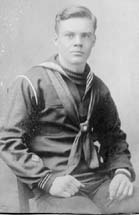
of the reports, written by Christina Nightingale ’00,
was an interview with Harry Brockington, a Naval veteran of World
War I. Brockington has died since Nightingale interviewed him, but
she came to know him well during their talks. She even invited him
to her family’s Christmas dinner when she discovered he’d
be spending the day alone. One
of the reports, written by Christina Nightingale ’00,
was an interview with Harry Brockington, a Naval veteran of World
War I. Brockington has died since Nightingale interviewed him, but
she came to know him well during their talks. She even invited him
to her family’s Christmas dinner when she discovered he’d
be spending the day alone.
"He was the life of the party," Nightingale said. "Here
was a 100-year-old man who lived on his own, cooked on his own,
and still drove. It was really amazing."
Nightingale described her initial meeting with Brockington at his
Vincentown home as a memorable experience. "A few moments after
I knocked on the door, a thin, older man with winged-tipped glasses
and a Mr. Rogers outfit appeared behind the glass. I had to contain
my surprise to see such an energetic, mobile and talkative 99-year-old
man."
An excerpt from Nightingale’s report provides a glimpse into
the process of learning through oral history: Well, as far as we
could find out, Chris, there was a submarine U-151 that came from
Germany loaded with mines. She dumped mines off the East Coast here
all the way up to New York, up to Fire Island. I think they came
over in early 1918. They might have come over in 1917 when we entered
the war with Germany. I imagine the mines we set up were at least
20 miles off, where big ships go. They wanted the big ships to hit
the mines, not the small ones. The big ships were at least 20 miles
off shore when they were coming in or going out.
Mr. Brockington’s claim of the U-151 leaving mines off the
East Coast to target larger ships was substantiated by the work
of Henry J. James. Traveling at a depth of 35 meters, the U-151’s
main objective was to plant mines in two areas: off the entrance
to the Chesapeake Bay to catch ships leaving Baltimore and off the
Delaware to intercept ships outward bound from the Delaware Bay.
Yet in addition to all of the important historical information Brockington
shared with Nightingale, one comment that he made about his minesweeping
efforts will always stay with her. "What we were doing was
saving lives, not killing," Mr. Brockington told her. "I’m
proud to say that."
Brockington was determined to make it to his 100th birthday—and
did, but died just weeks later. Nightingale took Brockington’s
death very hard. Every morning, she said, he would lift up his bedroom
shade to let his neighbors know he was okay. But one day, the shade
stayed down, she said.
|