|
Goldhagen makes his best argument by reasoning backward from what
perpetrators did to what could explain their conduct. He focuses
on the shooting operations that killed over a million Jews before
gassing became the principal method of execution, the work camps
in which the near-starvation and continual beating of Jewish laborers
undermined productivity, and the death marches of emaciated Jews
from one concentration camp to another in the final days of World
War II. As most of his critics concede, Goldhagen argues convincingly
that many of the perpetrators involved in these operations exhibited
cruelty, zeal, and celebratory attitudes that were clearly in excess
of what they were ordered to do. These characteristics, he asserts,
are entirely consistent with the thesis that Germans killed Jews
because they (mistakenly) believed Jews to be dangerous and demonic
enemies. They are not consistent, however, with any of the other
motives typically adduced to explain German conduct. Motives such
as peer pressure, obedience to authority, careerism, dullness, and
resignation to the horrors of war might explain the conduct of dutiful
executioners, Goldhagen argues, but they do not explain the conduct
of cruel, zealous, and celebratory executioners.
Goldhagen holds that by 1940–41, most Germans had come to believe
that Jews were an incorrigibly demonic race locked in apocalyptic
battle against the German people. Consequently, they believed that
the destruction of the Jewish race was “just” and even
“a beneficent act for humanity.” But Goldhagen overlooks
the need to explain how ordinary German perpetrators were able to
sustain beliefs that convinced them that torturing and killing Jews
was right, in the face of experiences that should have shaken those
beliefs. On this critical point he even fails to question his own
examples. How was it possible for a mature man putting a bullet
through the head of a 12-year-old child in some remote village in
Eastern Europe not to wonder whether that child was really his dangerous
and implacable enemy? How could staff members who helped supervise
Jews in the work camps not have been appalled by the fact that the
near-starvation and continual beatings of their Jewish slaves undermined
productivity that was becoming increasingly important to the German
war effort? How could the ordinary men and women who led the agonizing
death marches in the very last days of World War II continue to
think of their helpless victims as the greater enemy, when their
country was being reduced to rubble by powerful armies from East
and West?
Belief proper, as opposed to faith, is open to revision on the basis
of new experience. Why did so few German perpetrators revise their
beliefs during the war, whereas many revised their beliefs after
the war? According to Goldhagen: “During the Nazi period, and
even long before, most Germans could no more emerge with cognitive
models foreign to their society...than they could speak fluent Romanian
without ever having been exposed to it.” Yet this analogy is
obviously weak. Changing one’s beliefs about another people
is very different from becoming fluent in an unfamiliar language,
and models other than eliminationist anti-Semitism were readily
available to Germans both within German culture itself and within
the collective heritage of Western thought. A far better answer
is that the anti-Semitism that animated p erpetrators
was a passionate, and perhaps defensive, choice to be deceived.
It has often been noted that Jews were physically and psychologically
degraded during the Holocaust to “show” that they were
physically and psychologically inferior. The cruelty and zeal of
perpetrators may have been less the product of anti-Semitic beliefs
than ways of producing and sustaining those beliefs. In many cases,
the beliefs themselves may not have been the principal motives for
the commission of vicious acts, but ways of rationalizing and excusing
acts driven by other motives. erpetrators
was a passionate, and perhaps defensive, choice to be deceived.
It has often been noted that Jews were physically and psychologically
degraded during the Holocaust to “show” that they were
physically and psychologically inferior. The cruelty and zeal of
perpetrators may have been less the product of anti-Semitic beliefs
than ways of producing and sustaining those beliefs. In many cases,
the beliefs themselves may not have been the principal motives for
the commission of vicious acts, but ways of rationalizing and excusing
acts driven by other motives.
The Search for Answers
In the end, Goldhagen’s audacious bid to provide a simplified
explanation for the Holocaust fails. Indeed, the principal merit
of his book resides not in the answers that it gives but in the
questions that it raises. Reflecting on his own experiences in Auschwitz,
the Italian writer Primo Levi remarked: “The greater part of
historical and natural phenomena are [sic] not simple, nor simple
in the way we would like.” After 55 years of research, historians
have pieced together a fairly clear (though still incomplete) picture
of what happened during the Holocaust and identified the principal
factors that led to that tragedy. What remains uncertain is how
those factors interacted and their relative importance in the mix.
Part of this uncertainty stems from lack of information—especially
about the beliefs and attitudes of ordinary Germans. But the greater
obstacle is our imperfect understanding of human motivation and
conduct.
The yearning for understanding is an admirable trait and a source
of human dignity. We try to understand our world by bringing particular
things and events together under general concepts and laws or by
knitting them together in explanatory narratives. Thus, understanding
typically involves some form of simplification. The challenges for
us are to craft modes of understanding which give honest accounts
of available information and keep them open to revision or rejection
in light of new information. The dangers are always that we will
oversimplify and learn to ignore inconvenient facts.
Hitler’s Willing Executioners exemplifies one form of oversimplification.
A far more chilling form is Holocaust denial. Active Holocaust deniers,
like David Irving, are usually Nazi or neo-Nazi sympathizers who
share Hitler’s belief that deceit is a legitimate weapon for
achieving political ends. But the audience for Holocaust deniers
includes young people, often ignorant of history, who may be seduced
into taking seriously the simplest possible explanation for the
incomprehensibility of the Holocaust—namely, that it did not
happen. For those who know nothing about the mountain of evidence
that proves the murder of approximately five to six million Jews,
this might sound plausible. For those who are vaguely aware of the
evidence, there is always the standby myth that the Nazis used to
explain inconvenient facts: the worldwide Jewish conspiracy. But
this myth has a new twist. Since Germany provides both indispensable
documentation for the Holocaust and important Holocaust scholarship,
Holocaust deniers are put in the embarrassing position of having
to argue that the German establishment is now in league with Jewish
conspirators.
If the Holocaust can never be fully understood, why should we keep
trying? We should keep trying out of respect for those that suffered
and died. We should keep trying because knowledge of this kind is
worth having for its own sake. We should keep trying because the
Holocaust may help us to understand how to anticipate and prevent
genocidal behavior. The post-Holocaust cry of “never again”
has become something of a mockery in view of the millions of people
who were later murdered for ideological reasons in the Soviet Union,
China, and Cambodia and the hundreds of thousands who have been
murdered even more recently in campaigns of ethnic subjugation and
cleansing in places like East Timor, Guatemala, Bosnia, Rwanda,
and Kosovo. Clearly, the sheer horror of the Holocaust has not deterred
similar horrors. Nevertheless, the Holocaust remains the best documented
and most carefully studied case of genocide in history. As such,
it may yet help in the development of an early warning system for
detecting and diverting nations on the road to mass murder.
—
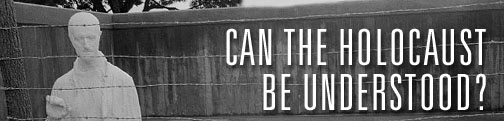
George Segal’s The Holocaust, Lincoln Park, San Francisco,
California. Photographed 1985, © Ira Nowinski/Corbis.
Barbed Wire from Holocaust Memorial at Mauthausen by
Fritz Cremer, Mauthausan Concentration Camp, Linz, Austria. Photographed
1987, © Ira Nowinski/Corbis.
Memorial Sculpture of Prisoners Laboring at Auschwitz Concentration
Camp, Auschwitz Concentration Camp Museum, Auschwitz, Poland. Photographed
1988, © Ira Nowinski/Corbis.
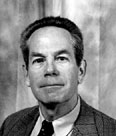 Richard Kamber is a professor of philosophy. He holds a BA from
Johns Hopkins University and a PhD from Claremont Graduate School.
Over the past four years he has given several papers at professional
meetings and written two articles on the Goldhagen debate. The first
article, “Goldhagen and Sartre on Eliminationist Anti-Semitism,”
was published by Holocaust and Genocide Studies, the scholarly journal
of the United States Holocaust Memorial Museum. The second, “The
Logic of the Goldhagen Debate,” is being published in the United
Kingdom by a journal
Richard Kamber is a professor of philosophy. He holds a BA from
Johns Hopkins University and a PhD from Claremont Graduate School.
Over the past four years he has given several papers at professional
meetings and written two articles on the Goldhagen debate. The first
article, “Goldhagen and Sartre on Eliminationist Anti-Semitism,”
was published by Holocaust and Genocide Studies, the scholarly journal
of the United States Holocaust Memorial Museum. The second, “The
Logic of the Goldhagen Debate,” is being published in the United
Kingdom by a journal
that specializes in philosophy and public affairs, Res Publica.
|