





 By Richard Kamber |
| In Elie Wiesel’s Night (1958), Moshe the Beadle
returns to the town of Sighet. After being deported as a foreigner,
he returns from the killing fields of Poland to tell the Jews of Sighet
that the Nazis are systematically exterminating Jews in Poland. No
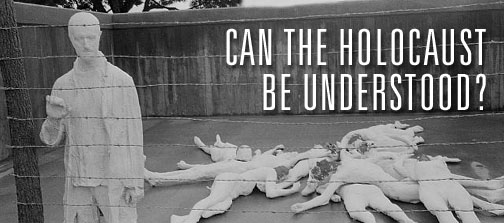
one believes him. In Wiesel’s words: “He went from one Jewish house to another, telling the story of Malka, the young girl who had taken three days to die, and of Tobias the Tailor, who had begged to be killed before his sons.... People not only refused to believe his stories, but even to listen to them.... ‘They take me for a madman,’ he would whisper, and tears...like drops of wax, flowed from his eyes.” This was in Hungary in 1942. About the same time, Jan Karski, a member of the Polish underground, made his way from Warsaw to London to meet with American officials and Jewish leaders. He told Justice Felix Frankfurter everything he knew about the slaughter of Jews in Poland. To which Frankfurter said, “I can’t believe you.” Assured that Karski was speaking the truth, Frankfurter replied “I did not say that this young man is lying. I said I cannot believe him. There is a difference.” The disbelief expressed by people who learned about the Holocaust during the Holocaust or shortly after the liberation of the death camps might be explained by the shock of the unexpected. Before World War II, few people could imagine any nation in Western Europe engaging in such relentless and systematically savage behavior toward non-combatants. It is not surprising that time would be needed to make the Holocaust comprehensible. What is harder to explain is why expressions of incomprehensibility have continued to be voiced by people who have had decades to study and reflect on the Holocaust. A Growing Interest in the Holocaust Since 1945, the examination of the Holocaust has grown exponentially into an industry bristling with academic departments, institutes, museums, journals, and racks of publications. In addition to extensive physical and documentary evidence, eyewitness testimony has been provided in abundance by survivors, rescuers, bystanders, and even perpetrators. And yet for many the mystery remains. In the process of writing The Nazi Doctors (1986), Robert Jay Lifton was warned by a survivor physician from Eastern Europe: “The professor would like to understand what is not understandable. We ourselves who were there, and who have always asked ourselves the question and will ask it until the end of our lives, we will never understand it, because it cannot be understood.” Some professors and scholars agree with this conclusion. Isaac Deutscher, for example, has written: “The fury of Nazism, which was bent on the unconditional extermination of every Jewish man, woman, and child within its reach, passes the comprehension of a historian, who tries to uncover the motives of human behavior.... [We] are confronted here by a huge and ominous mystery of the degeneration of the human character that will forever baffle and terrify mankind.” My professional interest in explaining the Holocaust began in Germany in 1996. In the late spring of that year I was on leave from The College and serving as a visiting professor at the Johan Wolfgang Goethe University in Frankfurt am Main, Germany. Since I was teaching classes in American philosophy and American higher education, there was no particular connection between the Holocaust and my teaching or research duties. What stimulated my interest were conversations I had with German friends and acquaintances. Although I seldom took the initiative in raising the subject, I found that many of the middle-aged or younger Germans I came to know were willing to speak frankly and personally about what their parents or grandparents did during the Third Reich. What I sensed in most of these conversations were feelings, not of guilt, for these people had done nothing themselves, but of shame and puzzlement. It seemed to me that they were ashamed of their relatives’ complicity in Hitler’s murderous regime and puzzled about how the events of the Holocaust could have happened. There was also talk in Germany about the publication of a new and audacious book on the Holocaust by a young political scientist at Harvard. The book was Daniel Goldhagen’s Hitler’s Willing Executioners: Ordinary Germans and the Holocaust (1996). When I returned to the United States in July, I bought a copy of Goldhagen’s book and found that it was audacious in more than one respect. Not only did Goldhagen claim that the extermination of the Jews had the support of almost the entire population of Germany, he also claimed as “the overall purpose of [his] book...to explain why the Holocaust occurred.” Hitler’s Willing Executioners soon became the focus of an international controversy and the target of searing criticism. Scores of articles and at least four books were devoted entirely to the debate over Goldhagen’s arguments. What fascinated me about this debate was that it depended as much on logical and conceptual distinctions as it did on issues of fact. As a philosopher, it seemed clear to me that the tools of my discipline—logic and conceptual analysis—could be of use here. |